¶ WELCOME TO THE STEELDOME WIKI
One operating system. Infinite possibilities. Enterprise storage, virtualization, Kubernetes, private cloud, AI, and HPC on a unified infrastructure foundation.
Welcome to the official SteelDome Wiki—the documentation and operational reference for StratiSYSTEM OS, StratiSTOR, StratiSERV, and HyperSERV.
Modern infrastructure must support established enterprise applications while adapting to cloud-native services, accelerated computing, and data growth. SteelDome brings these workloads together through a software-defined operating system built for supported industry-standard hardware, without imposing a single appliance architecture.
Use this wiki to evaluate, design, deploy, secure, operate, and scale SteelDome infrastructure—from compact edge systems to enterprise clusters, multi-site environments, private AI, and high-performance computing.
Choose the workload. Choose the architecture. Keep the operating foundation.
¶ STRATISYSTEM: THE INFRASTRUCTURE OPERATING SYSTEM
StratiSYSTEM OS is the common foundation behind SteelDome storage, compute, and hyperconverged solutions. It unifies the deployment, management, monitoring, protection, and lifecycle operations of services that would otherwise require separate infrastructure stacks.
Organizations can activate the services they need—software-defined storage, virtualization, Kubernetes, private cloud, advanced networking, GPU infrastructure, and AI—without creating an entirely new operating model for each technology.
The architecture stays flexible: dedicated storage or compute, converged HCI, third-party storage integration, edge nodes, GPU-enabled servers, and distributed sites can all be designed around workload and resilience requirements.
One platform for operational consistency. Open choice for infrastructure design.
¶ THE STRATISYSTEM PLATFORM
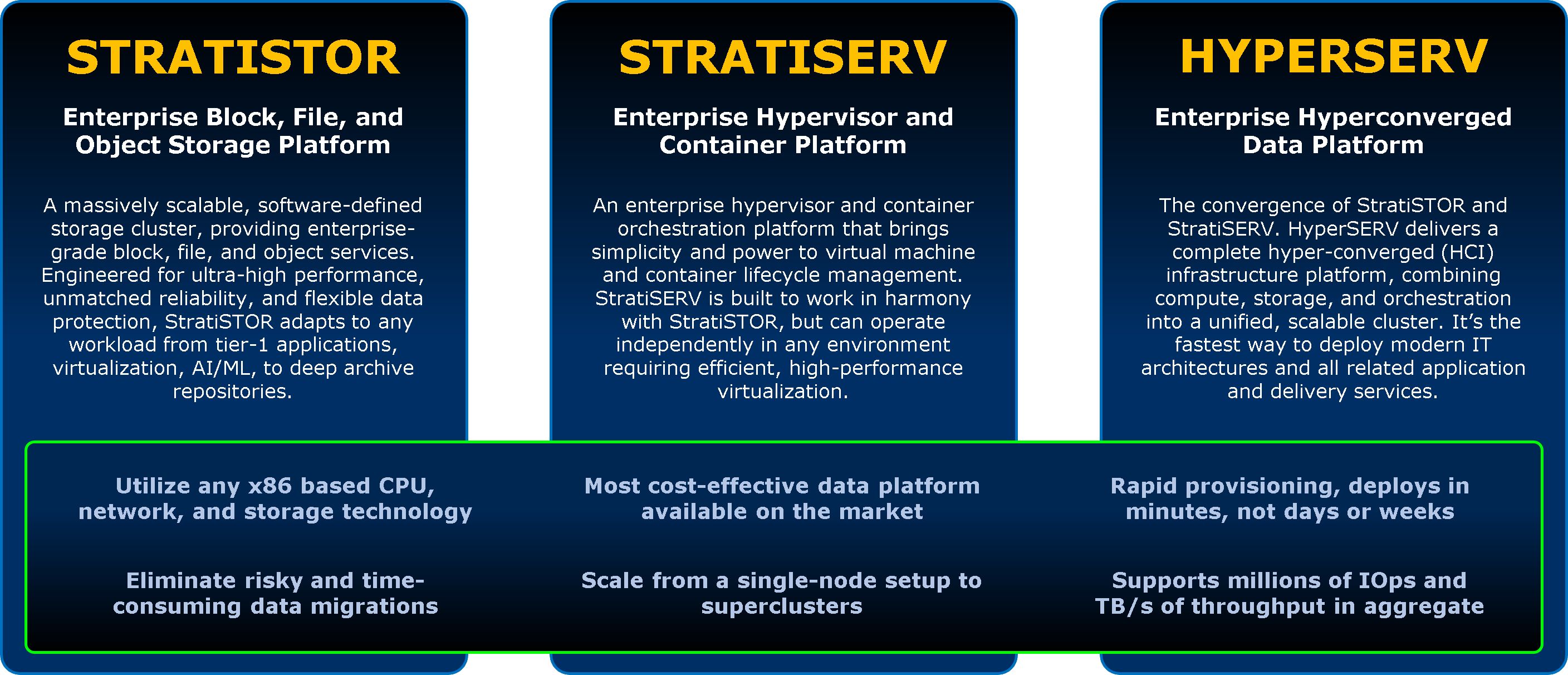
StratiSTOR delivers scale-out block, file, and object storage with flexible media choices, replication and erasure coding, data-integrity checking, snapshots, and high-performance data access. It supports enterprise applications, virtualization, databases, backup, AI datasets, and HPC workloads.
StratiSERV provides enterprise virtualization and workload services, including VM high availability, live migration, image-level backup, granular restore, scheduled replication, Kubernetes, automation, and supported GPU acceleration.
HyperSERV converges StratiSTOR and StratiSERV on the same nodes to combine enterprise compute and resilient storage with shared management. It supports compact HCI and larger clusters while allowing dedicated compute and storage resources to be incorporated as needs evolve.
¶ BUILT FOR WHAT INFRASTRUCTURE HAS BECOME
Enterprise IT now spans virtual machines, Kubernetes, GPU workloads, high-speed networking, continuously growing datasets, and geographically distributed services. Organizations need to modernize without multiplying infrastructure silos, management complexity, and vendor dependencies.
SteelDome addresses these requirements through a single software-defined foundation with workload-specific service and hardware choices.
| Virtualization Modernization | Modernize VMware-era and other legacy virtualization environments using StratiSERV or HyperSERV with live migration, high availability, VM protection, replication, and flexible storage integration. |
| Cloud-Native Infrastructure | Run enterprise VMs alongside Kubernetes and containers. Add supported OpenStack private-cloud services or deploy Red Hat OpenShift where that application platform is required. |
| AI and Accelerated Computing | Combine supported NVIDIA and AMD GPUs, GPU virtualization or passthrough, high-speed data paths, and locally hosted AI inference. Multi-model access, document retrieval, and optional CPU-distributed execution support private AI workflows. |
| High-Performance Data | Deliver scale-out block, file, object, NVMe-oF, and parallel Lustre services with SDCache, data-integrity protection, and high-throughput access for applications, AI pipelines, and HPC. |
| Accelerated Networking | Use qualified 25/100/200/400GbE systems and workload-specific RDMA/RoCE, SR-IOV, DPDK, VPP, and overlay technologies to support demanding storage and east-west traffic. |
| Private and Sovereign Infrastructure | Operate virtualization, storage, Kubernetes, and AI under enterprise control, including restricted or air-gapped environments. Apply supported identity, encryption, and PQC Fabric secure-routing capabilities where appropriate. |
| Distributed and Multi-Site Operations | Protect workloads across nodes and sites with replication, disaster recovery, failure-domain-aware placement, and qualified synchronous storage designs providing zero RPO for acknowledged writes under full protection. |
¶ WHY STEELDOME
The value of a modern infrastructure platform goes beyond an individual hypervisor or storage array. SteelDome combines hardware flexibility, common operations, and integrated data services so organizations can modernize at their own pace and scale resources without redesigning the entire environment.
| Hardware Freedom | Deploy on supported Intel and AMD x86 servers with workload-appropriate storage, networking, and accelerators instead of being restricted to one proprietary appliance design. |
| One Operating Foundation | Use consistent deployment, administration, monitoring, automation, security, and lifecycle workflows across storage, compute, HCI, Kubernetes, and supported AI infrastructure. |
| Composable Architecture | Choose StratiSTOR, StratiSERV, HyperSERV, or combined architectures; scale compute and storage together or independently according to the environment. |
| Scale Without Architectural Reset | Expand compute, storage capacity, networking, and accelerator resources incrementally while maintaining the underlying StratiSYSTEM operating model. |
| Automation and Observability | Centralize service and hardware health, VM and storage utilization, performance metrics, and operational tasks through supported web, CLI, and API workflows. |
| Lifecycle Independence | Modernize infrastructure in stages, preserve compatible existing investments, and avoid replacing the full software and management environment during each hardware refresh. |
¶ COMMON USE CASES
| VIRTUALIZATION MODERNIZATION | Move from legacy hypervisors and HCI using StratiSERV or HyperSERV with VM migration, high availability, live migration, backup, replication, and adaptable storage. |
| ENTERPRISE PRIVATE CLOUD | Deliver enterprise-controlled infrastructure with Kubernetes, OpenStack integration, software-defined networking, role-based access, APIs, and automation. |
| HYPERCONVERGED INFRASTRUCTURE | Combine StratiSERV compute and StratiSTOR storage on the same HyperSERV nodes while retaining options for dedicated compute or capacity expansion. |
| SOFTWARE-DEFINED STORAGE | Build scalable block, file, object, and high-performance storage using supported NVMe, SSD, HDD, and external devices, with configurable data protection. |
| AI AND GPU INFRASTRUCTURE | Support GPU-enabled private AI, model inference, data retrieval, and accelerated applications with NVIDIA or AMD compute, high-speed networking, and StratiSTOR storage. |
| HPC AND RESEARCH | Support scientific workloads, analytics, simulation, and rendering through Lustre, scalable compute, GPU resources, and high-bandwidth storage and networking. |
| KUBERNETES AND CLOUD-NATIVE | Operate Kubernetes and traditional VMs side by side with common compute, networking, persistent storage, monitoring, and lifecycle management. |
| VDI | Deliver centrally managed virtual desktops with data protection, security policy, scalable storage, and GPU acceleration where supported and required. |
| EDGE AND ROBO | Extend the same operating model to branch offices, industrial locations, labs, and remote facilities with appropriately sized compute and storage. |
| DISASTER RECOVERY AND MULTI-SITE | Plan for site failures with storage protection, VM backup, scheduled replication, multi-site placement, and recovery workflows aligned to RPO and RTO requirements. |
| SERVICE PROVIDER AND MULTI-TENANT CLOUD | Deliver managed or private infrastructure services using resource isolation, role-aware administration, APIs, and scalable storage, compute, and networking. |
| AIR-GAPPED AND SOVEREIGN INFRASTRUCTURE | Host sensitive workloads and locally managed AI in restricted networks with controlled repositories, infrastructure access, and supported security features. |
¶ FROM EDGE TO ENTERPRISE TO AI
A small edge installation and a high-capacity enterprise cluster can use the same StratiSYSTEM operational principles. A virtualization deployment can add Kubernetes, an existing storage environment can expand into HCI, and GPU-enabled systems can support private inference or HPC as requirements change.
The goal is not to fit every workload into one hardware design. It is to provide a consistent operating system that supports the right architecture for each workload.
¶ USE THIS WIKI TO BUILD AND OPERATE STRATISYSTEM
This wiki is for architects, administrators, engineers, partners, and service providers. It provides the platform specifications and procedures needed for installation, provisioning, storage, virtualization, Kubernetes, AI, networking, data protection, security, troubleshooting, and lifecycle operations.
Begin with Features and Specifications and the Installation Guide. Use the Partner Deployment Guide for structured rollout, the User and Advanced User Guides for operation, and the dedicated AI Deployment and PQC Fabric guides for those specialized services. The navigation menu provides access to each topic.
¶ BUILD INFRASTRUCTURE AROUND THE WORKLOAD—NOT THE LIMITATIONS OF THE PLATFORM
Processor generations, storage media, networking, accelerators, and application architectures will keep evolving. An infrastructure operating system should give organizations the flexibility to adopt those advances without repeatedly replacing their entire operational foundation.
StratiSYSTEM is designed to bring new technologies and services into a consistent infrastructure model, while retaining appropriate hardware and deployment choice.
Modernize what you have. Deploy what you need. Scale what matters. Keep control.