INTRODUCTION TO STRATISERV
StratiSERV is a virtualization platform that unifies virtual machines, containers, and infrastructure management—designed to simplify operations, maximize resource efficiency, and deliver enterprise-grade performance across any environment.
STRATISERV: ENTERPRISE VIRTUALIZATION AND COMPUTE INFRASTRUCTURE
Unified Compute. Flexible Infrastructure. Uncompromising Architectural Freedom.
StratiSERV is the software-defined compute foundation of StratiSYSTEM OS. It brings enterprise virtualization, Kubernetes, containers, private cloud, virtual desktops, and accelerated computing together under a common operating model, allowing organizations to modernize established applications while introducing new workload services.
Built on supported industry-standard Intel and AMD x86 servers, StratiSERV separates compute services from proprietary appliance designs and fixed storage architectures. Organizations can select processors, memory, networking, accelerators, and storage according to workload requirements while retaining consistent management, protection, and lifecycle operations.
Modernize the compute platform without limiting where your infrastructure can go next.
ONE COMPUTE FOUNDATION. MULTIPLE WORKLOAD ARCHITECTURES.
StratiSERV transforms physical server resources into centrally managed virtual machine and container infrastructure. Dedicated compute clusters can connect to StratiSTOR or compatible third-party block and file storage, or converge with StratiSTOR through HyperSERV. Shared storage enables eligible workload mobility and high availability while preserving the ability to scale compute and storage independently.
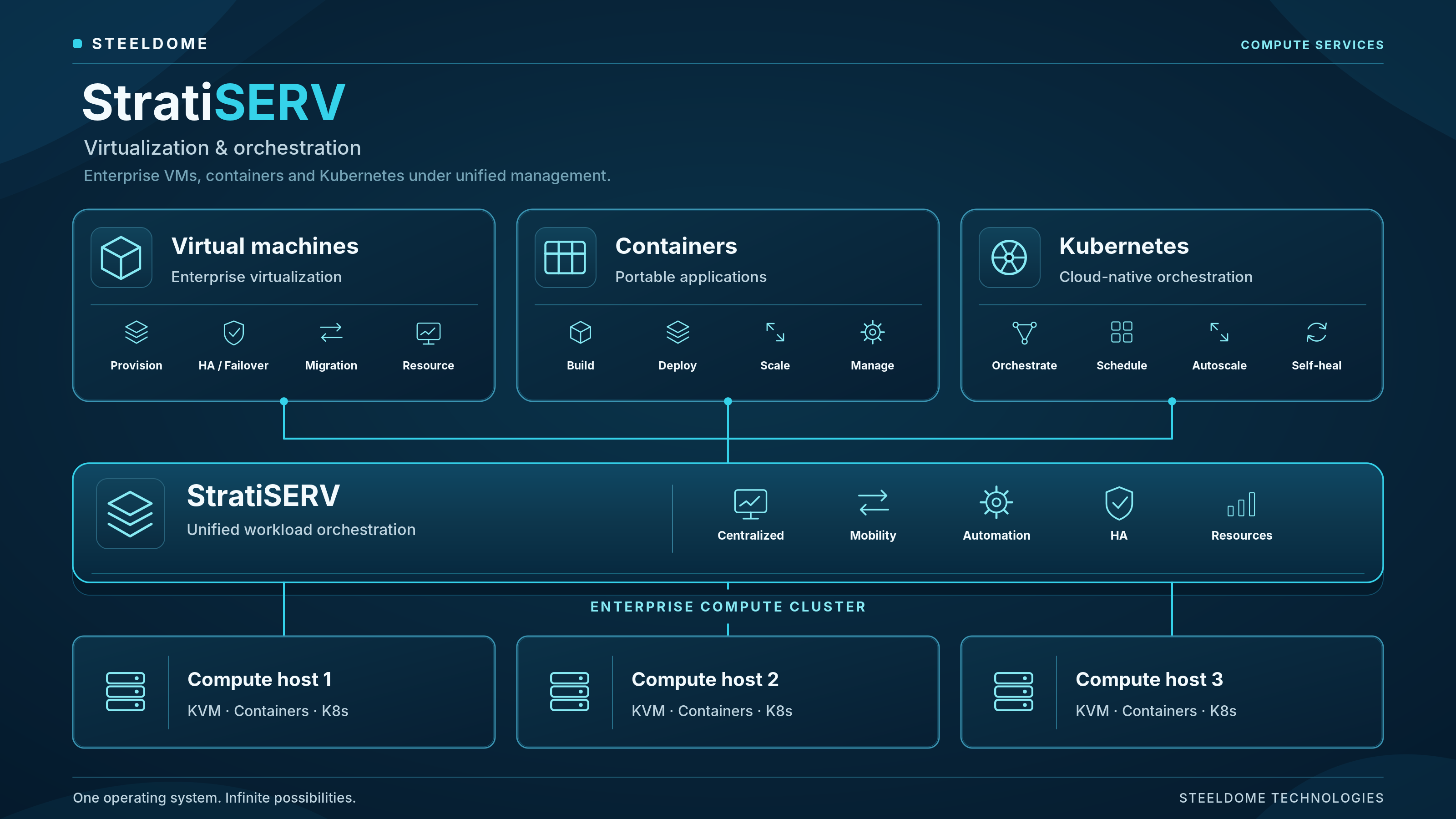
This architecture accommodates compact edge deployments, enterprise compute clusters, GPU-oriented systems, and distributed infrastructure without requiring a different operating environment for each deployment model.
ENTERPRISE VIRTUALIZATION AND WORKLOAD MOBILITY
StratiSERV provides integrated virtual machine lifecycle management, including provisioning, templates, virtual hardware configuration, monitoring, snapshots, and workload protection. Administrators can manage CPU, memory, disks, network interfaces, firmware, guest security, and supported assigned devices through a consistent workflow.
Cluster high availability can restart protected VMs on eligible surviving hosts, while live migration and supported live storage migration enable maintenance, workload redistribution, and infrastructure refresh with limited application interruption. Per-VM CPU compatibility profiles allow migration across validated processor generations without imposing a single global CPU baseline. Quorum, available capacity, storage access, networking, and device assignments determine recovery and mobility eligibility.
For organizations transitioning from VMware, Hyper-V, or other virtualization environments, supported import and migration workflows enable phased modernization. Compatible storage can remain in service as compute is refreshed, or organizations can introduce StratiSTOR and HyperSERV as their architecture evolves.
INTEGRATED WORKLOAD PROTECTION AND RECOVERY
Data protection is part of the compute operating model rather than an isolated administrative process. StratiSERV integrates image-level VM backup, multi-disk protection, full workload recovery, and granular file-level restore for supported Linux and Windows guest filesystems. Authorized recovery of supported encrypted guest volumes is possible where the required keys and filesystem capabilities are available.
Scheduled VM replication supports disaster recovery and controlled failover to configured destinations, with on-demand execution and centralized job monitoring. Recovery planning accounts for guest consistency, virtual disks, UEFI state, and virtual TPM state as applicable. Point-in-time snapshots complement independent backup and recovery copies rather than replacing them.
Combined with appropriate shared storage and recovery infrastructure, these capabilities help organizations design protection around application availability, recovery point objective (RPO), and recovery time objective (RTO) requirements. High availability, backup, and replication serve different recovery purposes and should be designed together.
BUILT FOR MODERN COMPUTE WORKLOADS
Kubernetes, Private Cloud, and Application Platforms
Kubernetes infrastructure is included with StratiSERV, allowing enterprise VMs and cloud-native applications to coexist with common hardware, networking, monitoring, and supported persistent storage. Optional OpenStack services can extend this foundation for private-cloud architectures, while Red Hat OpenShift can be deployed on supported StratiSYSTEM infrastructure where its application platform is required.
This enables existing applications, development and CI/CD environments, service-provider workloads, and new containerized services to share infrastructure without requiring every application to be rewritten during modernization.
Private AI, GPU Acceleration, and High-Performance Computing
StratiSERV supports AI training, inference, visualization, engineering, scientific computing, and virtual desktop infrastructure through qualified NVIDIA and AMD GPU technologies. GPU passthrough provides direct device access to eligible VMs, while compatible NVIDIA vGPU, AMD virtualization options, and ROCm configurations address shared or accelerated compute requirements. GPU selection and assignment affect software compatibility, licensing, workload mobility, and eligible recovery hosts.
Optional self-hosted AI services support local CPU- or GPU-based model serving, a shared multi-model web interface, retrieval-augmented generation (RAG), and supported distributed CPU inference. GPU monitoring provides visibility into supported devices, while qualified GPUDirect data paths, high-speed storage, and DPU acceleration can complement demanding workloads where end-to-end compatibility has been validated.
Advanced Networking and Accelerated Data Paths
StratiSERV supports conventional Linux networking alongside workload-specific VLAN, VXLAN, Geneve, OVN, SR-IOV, RDMA/RoCE, DPDK, VPP, and supported hardware-offload configurations. Virtual networks, routing policies, segmentation, and access controls enable separation of management, storage, tenant, and application traffic.
High-speed Ethernet and optional accelerated packet processing can be introduced where latency, throughput, or CPU efficiency demands it. Physical network capacity, PCIe bandwidth, NUMA placement, queues, MTU, and device compatibility remain important to the complete data path.
Security, Isolation, and Sovereign Infrastructure
Role-aware administration, network segmentation, workload isolation, virtual TPM, and supported UEFI Secure Boot configurations provide a foundation for protecting the management plane and hosted workloads. Confidential-computing technologies such as Intel TDX and AMD SEV depend on compatible hardware, firmware, software, and guest configurations.
Organizations can operate private cloud, virtualization, Kubernetes, and AI services under their own administrative control, including appropriately configured restricted or air-gapped environments with local services and offline software repositories.
THE STRATISERV DIFFERENCE
StratiSERV combines the capabilities of an enterprise hypervisor with a broader software-defined compute operating model, retaining choice in workload placement, storage architecture, and infrastructure evolution.
UNIFIED WORKLOAD SERVICES Operate enterprise VMs, Kubernetes, private cloud, and accelerated workloads on a common compute foundation. | HARDWARE AND STORAGE FREEDOM Choose supported industry-standard servers and compatible storage, or converge compute and storage through HyperSERV. | WORKLOAD MOBILITY Modernize existing virtualization environments and move eligible workloads across compatible hosts and storage destinations. |
INTEGRATED WORKLOAD PROTECTION Combine cluster HA, snapshots, image-level backup, granular restore, and scheduled VM replication. | ACCELERATED COMPUTE AND NETWORKING Introduce qualified GPU, high-speed networking, and hardware acceleration technologies as applications demand them. | UNIFIED OPERATIONS Centralize provisioning, monitoring, automation, maintenance, and lifecycle management across compute infrastructure. |
FROM EDGE COMPUTE TO ENTERPRISE SCALE
StratiSERV supports compact single-node deployments for workloads that accept the absence of node-level HA, qualified dual-node designs with appropriate quorum and fencing, and multi-node clusters for enterprise workloads. Dedicated, tiered, hyperconverged, hybrid, and multi-site architectures can incorporate compute, storage, and GPU resources according to workload density, availability, and growth requirements.
Centralized observability provides visibility into host and VM utilization, workload state, storage and network health, hardware telemetry, GPU metrics, and historical resource trends. Web administration, CLI tools, and supported REST API workflows help standardize provisioning, protection, maintenance, and integration with broader operational systems.
Supported rolling maintenance, compatible workload migration, and phased hardware replacement allow compute resources to evolve while maintaining the operating model. Multi-site deployments can combine StratiSERV with protected storage for geographic recovery or workload placement, subject to the selected network, storage, and quorum design.
DESIGNED FOR CONTINUOUS INFRASTRUCTURE EVOLUTION
The value of StratiSERV goes beyond hypervisor replacement. Organizations can preserve compatible infrastructure investments, scale compute independently of storage, adopt new processors and accelerators, and introduce cloud-native and AI applications without repeatedly replacing their compute operating foundation.
Explore the StratiSYSTEM Features and Specifications for detailed platform capabilities, the General System User Guide for workload management and protection, the Advanced User Guide for advanced configuration, and the AI Deployment Guide for supported private AI services.
Modernize your workloads. Expand your capabilities. Preserve your operating foundation.
One operating system. Infinite possibilities.