INTRODUCTION TO STRATISTOR
StratiSTOR is a software-defined storage platform engineered to deliver massive scalability, high performance, and unified block, file, and object services—purpose-built to power the most demanding enterprise and data-centric workloads.
STRATISTOR: ENTERPRISE SOFTWARE-DEFINED STORAGE
Unified Data Services. Distributed Resilience. Uncompromising Architectural Freedom.
StratiSTOR is the software-defined data foundation of StratiSYSTEM OS. It brings enterprise block, file, object, and high-performance storage together within a distributed platform designed for traditional applications, virtualization, private cloud, artificial intelligence, and high-performance computing (HPC).
Rather than tying data services to a proprietary storage appliance, StratiSTOR transforms supported industry-standard Intel and AMD x86 infrastructure into a scalable storage environment. Organizations can select NVMe, SSD, HDD, compatible external storage, networking, and protection policies according to workload requirements while maintaining a consistent operating model.
Enterprise data should outlive the hardware that stores it.
ONE DATA PLATFORM. MULTIPLE STORAGE SERVICES.
StratiSTOR consolidates diverse storage requirements without assuming every application needs the same data path. Block storage is available through supported iSCSI and NVMe over Fabrics (NVMe-oF) interfaces, file services through SMB and NFS, and object storage through S3-compatible APIs. Additional supported access and transfer methods, including HTTPS and SFTP, address specialized requirements.
These services share the same underlying infrastructure while retaining workload-specific access, availability, security, and protection settings. All-NVMe, all-flash, hybrid, capacity-oriented, and tiered configurations allow performance and capacity to be engineered around the applications they serve.
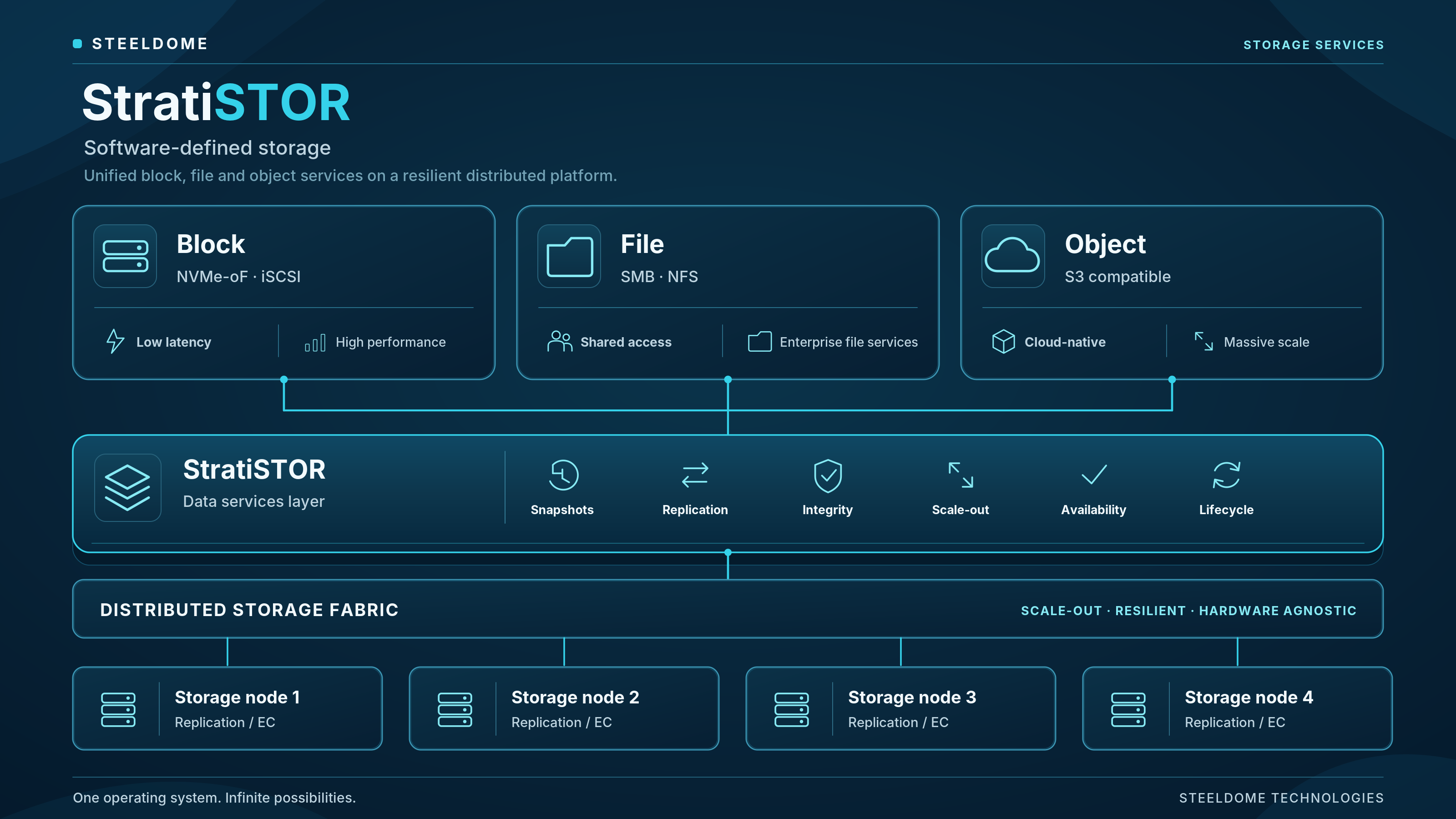
By distributing data and services across participating nodes rather than relying on a fixed controller pair, StratiSTOR allows capacity and aggregate performance to grow as supported devices and nodes are added. Compatible external and multipath block devices can also be incorporated where appropriate.
PERFORMANCE DESIGNED AROUND THE WORKLOAD
Storage performance is determined by the entire data path, not simply the speed of the underlying drives. StratiSTOR brings together modern storage media, processor and memory resources, networking, caching, and metadata placement to support workloads ranging from latency-sensitive databases to large-scale parallel data processing.
Qualified high-performance configurations can combine NVMe, 100/200/400GbE networking, RDMA/RoCE, multipathing, NUMA-aware resource placement, and supported platform acceleration technologies. StratiSYSTEM also provides selected SR-IOV, DPDK, VPP, VLAN, overlay networking, quality-of-service, and hardware-offload capabilities, depending on the protocol and hardware configuration.
Dedicated metadata resources can improve performance for large namespaces and small-file workloads. SDCache provides configurable cache acceleration and a device-presentation layer for supported storage configurations, with cache sizing and write policies selected according to workload and recovery requirements.
For AI, scientific research, simulation, media processing, and HPC, scalable file and object services can be combined with supported Lustre parallel filesystem deployments and high-bandwidth compute fabrics. The goal is to deliver data at the rate applications can consume it, while balancing latency, throughput, capacity, and infrastructure cost.
RESILIENCE, DATA INTEGRITY, AND IMMUTABILITY
StratiSTOR protects data through configurable replication and erasure coding, with placement policies that can reflect device, node, rack, and site failure domains. These protection models allow organizations to balance usable capacity, performance, and recovery objectives rather than applying one redundancy policy to every workload. Supported compression can further improve capacity efficiency where appropriate.
Checksumming, background scrubbing, consistency checks, and distributed recovery help detect data corruption and restore redundancy when valid protected copies or reconstructable fragments are available. Point-in-time snapshots support recovery, rollback, and testing, while independent backups remain essential to a complete data protection strategy.
For retention-sensitive applications, S3 Object Lock provides object-version WORM (Write Once, Read Many) protection through supported governance and compliance retention modes and legal holds. This complements snapshot-based recovery and can support compatible immutable backup repositories and archives. Object Lock enforcement applies at the S3 interface; privileged infrastructure access requires separate security controls.
Supported encryption at rest, secure protocol access, role-aware administration, and isolated management networks help protect the data environment. Local services and offline software repositories also support appropriately configured restricted or disconnected deployments.
Synchronous Multi-Site Protection
Qualified synchronous architectures can extend StratiSTOR across independent data sites, providing zero recovery point objective (RPO) for acknowledged writes while full cross-site synchronous protection is maintained. Independent quorum or tiebreaker resources, appropriate network latency and bandwidth, and sufficient recovery capacity are essential to the design.
Zero RPO does not imply zero recovery time. Degraded single-site operation may temporarily have different protection characteristics, and multi-site access must be validated for the specific protocol, application, and topology. Asynchronous replication and independent recovery copies can complement synchronous protection.
A DATA FOUNDATION FOR MODERN INFRASTRUCTURE
Enterprise Applications, Virtualization, and Private Cloud
StratiSTOR provides shared data services for transactional databases, enterprise applications, StratiSERV, HyperSERV, compatible third-party hypervisors, and Kubernetes environments. Dedicated storage clusters allow capacity and performance to grow independently of compute, while converged deployments bring storage and workload services together on the same nodes.
AI, High-Performance Computing, and Research
Training datasets, model weights, checkpoints, inference artifacts, scientific datasets, and simulation outputs can be served through scalable data repositories and workload-specific high-performance storage designs. Supported NVMe, GPU-oriented data paths, high-speed networking, and complementary Lustre configurations help address concurrent access and sustained throughput requirements.
Enterprise File Services, Object Storage, and Data Protection
SMB and NFS support shared enterprise files, engineering data, media workflows, and collaboration, with SMB multichannel available where supported. S3-compatible storage serves application content, analytics, backup targets, and long-term archives. Capacity-oriented configurations accommodate growing retention requirements without constraining performance-sensitive workloads to the same media or protection policy.
THE STRATISTOR DIFFERENCE
StratiSTOR combines the capabilities of traditionally separate storage platforms with the freedom to select how data services are physically implemented, protected, and scaled.
UNIFIED DATA SERVICES Deliver block, file, object, and high-performance data services from one software-defined storage foundation. | HARDWARE FREEDOM Select supported server, media, and network configurations based on actual workload requirements. | FLEXIBLE SCALE-OUT GROWTH Expand storage capacity and aggregate service resources incrementally through supported devices and nodes. |
WORKLOAD-DRIVEN PERFORMANCE Combine NVMe, caching, metadata acceleration, and qualified high-speed data paths to meet application needs. | INTEGRATED DATA RESILIENCE Apply configurable protection, integrity checks, snapshots, object retention, and qualified multi-site architectures. | UNIFIED OPERATIONS Manage provisioning, monitoring, recovery, maintenance, and lifecycle workflows through a consistent operating environment. |
FROM EDGE STORAGE TO ENTERPRISE SCALE
StratiSTOR can be deployed as a compact single-node system for laboratories, development, or edge workloads that accept the absence of node-level high availability; as a dedicated multi-node storage cluster; or as part of a larger disaggregated, hyperconverged, hybrid, or multi-site environment. The same operating model remains consistent as hardware, topology, and service requirements evolve.
Centralized observability provides visibility into device and node health, capacity, service status, performance, scrubbing, recovery, and placement activity. Web, CLI, and supported REST API workflows help standardize provisioning, monitoring, maintenance, and troubleshooting.
Supported online expansion, rolling maintenance, and phased hardware replacement allow the storage environment to evolve without a wholesale platform reset, provided cluster health, redundancy, and recovery capacity permit the planned changes.
DESIGNED TO EVOLVE WITH THE DATA
Data growth, new application architectures, faster networks, and emerging storage technologies should not force organizations to repeatedly replace their entire storage foundation. StratiSTOR provides a consistent software-defined platform that can evolve alongside the workloads it serves.
Explore the StratiSYSTEM Features and Specifications for detailed platform capabilities, the User Guide for day-to-day administration, and the Advanced User Guide for storage service configuration, WORM retention, synchronous replication, and advanced infrastructure design.
Expand capacity. Refresh the hardware. Preserve the data platform.
One operating system. Infinite possibilities.